
Voice and Data Cabling
Serving the Front Range of Colorado, Wyoming, and New Mexico
High Country Workplace Technologies can provide cabling and fiber optic internet in Denver and the surrounding areas so that your enterprise always has the Internet speed necessary to succeed in today’s business marketplace.
The Right Speed At the Right Location
When you don’t have enough speed on a desktop because your Internet is sluggish, it slows down your productivity and costs the company money. Alternatively, you can also be paying too much for Internet speed in an area that doesn’t need it. Both scenarios mean your cabling and fiber optics aren’t cost effective. We can help you get the right speed at the right location, so you have efficient fiber optic internet in Denver that can save you money in the long run. We are experts at listening to your needs and configuring the right solution to solve your cabling and fiber optic internet needs.
Upgrading to Fiber Optic Internet In Denver
When it’s time to upgrade your bandwidth, fiber optic internet in Denver is the go-to choice. Don’t worry. We can help you find the least expensive carrier and facilitate the entire upgrade process from designing the fiber optic framework to preparing the installation, to testing and certifying.
Designing the Fiber Optic Pathways
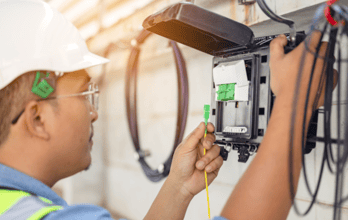
Some locations in your enterprise require more bandwidth speed than others. For example, the accounting department is primarily running spreadsheets and doesn’t need a great deal of Internet speed. One hundred megs of speed will work just fine for them. However, the engineering department is working with CAD software and online 3D imaging, so they need a gigabyte of bandwidth speed. We work with you to determine your cabling needs based on today’s needs and tomorrow’s. We make sure your fiber optic internet in Denver is correctly sized so you’re not paying for speed you don’t utilize.
Preparing Your Location For Fiber Optic Internet In Denver
Once the design plan is completed, you’ll need a pathway to be made for the fiber that will run from the outside of your building to the inside. The area must be prepared correctly, or it costs you time and money.
We can facilitate the development of the required pathway for your fiber optic internet in Denver because we have experience with all the potential challenges – from buried conduits and pathways to IT closets to negotiating with trenching and boring companies and working with the carriers themselves. We know what they need to be able to lay cable or fiber optics, and we can put all the pieces into place, so you have a smooth transition.
Terminate, Test, & Certify
After the cable or fiber optic internet has been laid, we test it to make sure the certified bandwidth is going through the cable or fiber that’s been installed. We then certify our work so you can be assured you’ve gotten what you’ve paid for. There’s no better choice for cable or fiber optic internet in Denver.
Get Rid Of The Mess of Cables
Perhaps you’re struggling with a mess of cables that are unsightly and unwieldy. No one wants to touch them for fear of messing up the network. We can organize the cables that run from the desktops to the IT closet to improve security, increase manageability, and create a less chaotic aesthetic. Contact us to schedule a free cable assessment to see if it’s time to clean up your cable or replace it with fiber optic internet in Denver or the surrounding areas.
Frequently Asked Questions About Voice, Data, and Fiber-Optic Cabling
What types of business cabling does HCWT install?
High Country Workplace Technologies designs and coordinates the installation of structured voice and data cabling, Ethernet cabling, fiber-optic connections, equipment-room cabling, patch panels, equipment racks, pathways, and related network infrastructure. HCWT can support new construction, office renovations, relocations, network upgrades, wireless access points, telephone systems, cameras, and other connected devices.
Should a business install Cat6, Cat6A, or fiber-optic cabling?
The appropriate cable depends on distance, required speed, equipment, environment, budget, and expected future use. Cat6 is suitable for many office connections, while Cat6A may be preferred for higher-speed applications and installations that need additional performance margin. Fiber is commonly used for building backbones, longer distances, high-bandwidth connections, and links between buildings. HCWT evaluates each location before recommending a cable type.
When should office cabling be replaced or upgraded?
Cabling should be evaluated when it cannot support required network speeds, has damaged connectors or insulation, fails certification testing, creates intermittent connections, or does not meet the requirements of new phones, computers, wireless access points, cameras, or other equipment. Cabling should also be reviewed during an office move, renovation, network upgrade, or telephone-system replacement.
What is structured cabling?
Structured cabling is an organized system of cables, connectors, patch panels, racks, pathways, labels, and telecommunications spaces. It provides a consistent physical foundation for computers, phones, wireless access points, cameras, paging systems, building devices, and other network equipment. A structured design makes the network easier to manage, troubleshoot, expand, and document.
When is fiber better than copper Ethernet cabling?
Fiber is generally preferred for longer distances, connections between buildings, network backbones, electrically noisy environments, and applications requiring high bandwidth. Copper Ethernet remains practical and cost-effective for many individual workstations, phones, cameras, printers, and wireless access points. Many organizations use fiber for backbone connections and copper cabling for connections to individual devices.
Can existing cabling support cloud phones and business Wi-Fi?
Possibly. Cloud phones and wireless access points depend on the quality and capacity of the underlying wired network. Existing cabling may be suitable if it supports the required speed, Power over Ethernet, switch connections, and installation standards. HCWT can inspect and test the cabling to determine whether it can be reused or should be repaired, reorganized, or replaced.
What does it mean to test and certify network cabling?
Cable testing checks whether an installed connection is properly terminated and free from faults such as opens, shorts, crossed pairs, or excessive signal loss. Certification uses specialized equipment to verify that the cable meets the performance requirements of its specified category or fiber standard. Certification results provide documented evidence that the installed cabling performs as intended.
Can HCWT organize and label an existing network closet?
Yes. HCWT can help reorganize tangled or undocumented cabling, identify connections, label cables and patch-panel ports, replace damaged patch cords, improve rack organization, and document the completed work. A properly organized telecommunications room makes future service, equipment replacement, troubleshooting, and network expansion more efficient.
What preparation may be required before installing fiber?
A fiber installation may require an approved pathway from the carrier entrance or network room to the required destination. Preparation can include conduit, innerduct, sleeves, core drilling, trenching, boring, pull boxes, equipment racks, power, grounding, and coordination with the building owner or carrier. HCWT can help identify these requirements and coordinate the necessary contractors and service providers.
Can cabling be installed without interrupting business operations?
Many cabling projects can be completed in phases or scheduled outside normal operating hours to reduce disruption. The installation plan may include preparing pathways, installing and testing new cables, configuring equipment, and moving users in controlled groups. The amount of interruption depends on the building, existing infrastructure, safety requirements, and project scope.
How does HCWT manage a cabling and fiber-optic project?
High Country Workplace Technologies begins by reviewing the organization’s locations, devices, network design, bandwidth requirements, existing cabling, and future plans. HCWT can assist with system design, carrier coordination, pathway planning, installation, termination, testing, certification, labeling, documentation, equipment-room organization, and integration with telephone, Wi-Fi, camera, and other communication systems.
Moving? Upgrading Your PBX System?
If you are relocating or upgrading your other communications technology, you’ll mostly likely need new cabling. We can be your one-phone-call solution because we can design and lay cabling as well as create the end user communication solution. Contact High Country to solve your cabling and fiber optics issues.