
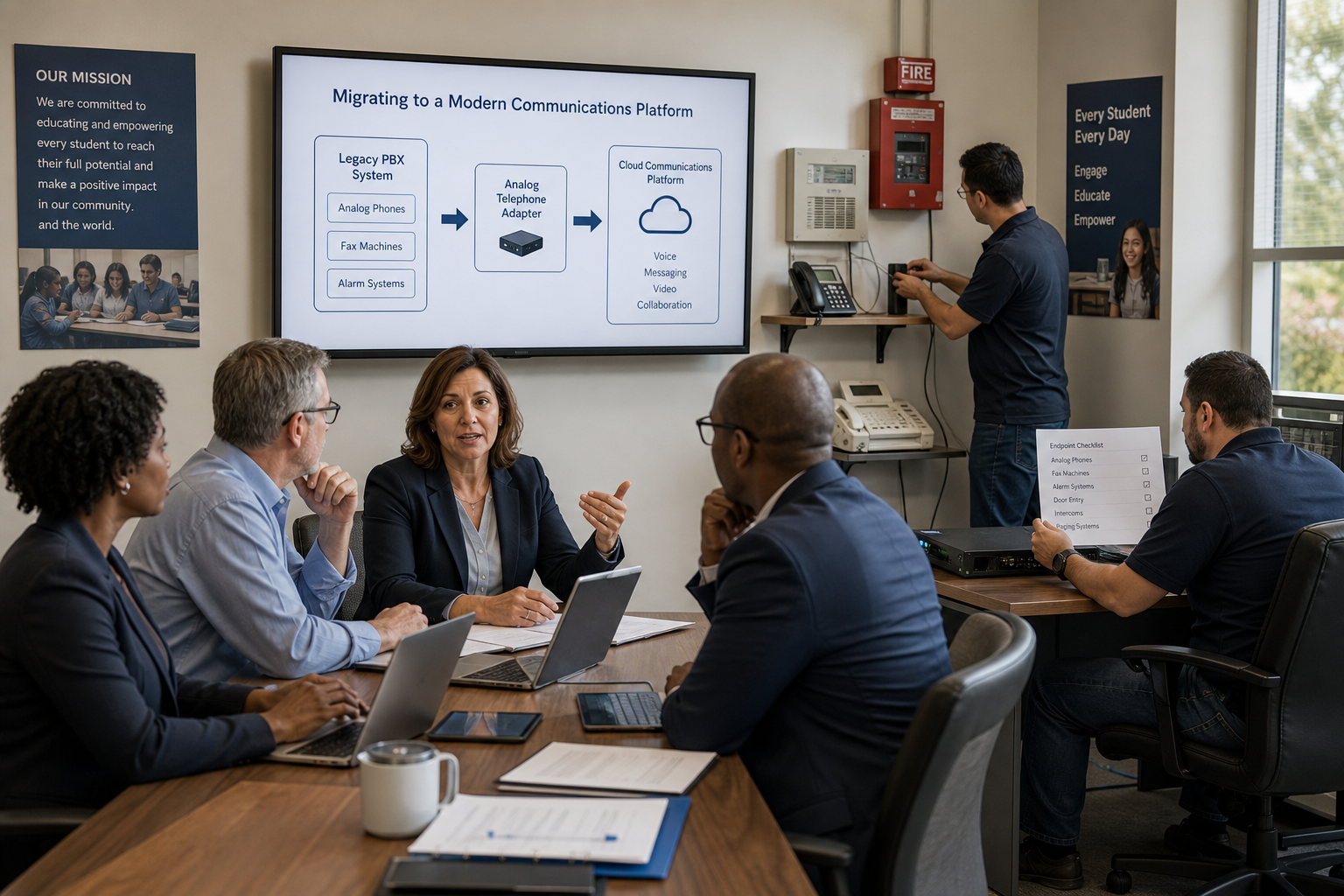
 Moving a school district from a legacy PBX to RingCentral does not mean every fax machine, emergency phone, paging interface, or analog endpoint must be replaced immediately. By combining RingCentral’s cloud communications platform with MetTel’s POTS Transformation service, districts can modernize staff communications while maintaining the specialized analog services that schools still depend on.
This complementary approach allows a district to migrate at a manageable pace without leaving critical analog devices behind.
Why Analog Endpoints Complicate a School Phone-System Migration
A typical school district has more analog connections than may appear in its PBX inventory. These endpoints are often distributed across schools, administrative offices, transportation facilities, maintenance buildings, stadiums, and other locations.
Common examples include:
- Fax machines and multifunction printers
- Classroom and office analog phones
- Elevator emergency phones
- Fire and burglar alarm panels
- Door-entry and intercom systems
- Emergency call boxes
- Overhead paging interfaces
- Modems and building-management equipment
- Point-of-sale and cafeteria devices
Many of these devices were designed to receive traditional analog dial tone from the district’s PBX or a telephone-company copper line. Although a cloud phone platform can replace the primary PBX, it may not be appropriate to connect every specialty device to standard Voice over Internet Protocol service.
The solution is to classify each endpoint and select the right migration path.
RingCentral Supports Staff, Classroom, Fax, and General-Purpose Analog Communications
RingCentral becomes the district’s primary communications platform, replacing the legacy PBX for administrators, teachers, support personnel, and common areas.
Users can communicate through supported desk phones, computers, tablets, and mobile devices. Districts can also centrally manage phone numbers, extensions, call routing, auto attendants, voicemail, emergency-calling configurations, and other communications features across multiple schools.
For analog devices that can operate reliably over a cloud voice connection, RingCentral supports analog telephone adapters, commonly called ATAs. An ATA converts the signal from an analog device into a format that can travel over the district’s IP network.
RingCentral identifies traditional telephones, fax machines, and overhead paging equipment as potential ATA applications. Its supported Cisco ATA models provide analog ports for connecting compatible devices to RingCentral service. RingCentral device information
This can provide a practical migration path for:
- A fax machine that the district needs to retain
- An analog telephone in a maintenance or storage area
- A courtesy phone with basic calling requirements
- A paging-system interface that accepts an analog station or trunk connection
- Other nonsafety analog endpoints that have been tested for compatibility
RingCentral also offers electronic fax capabilities. In many cases, a district can eliminate a physical fax machine by allowing authorized employees to send and receive faxes electronically. Physical fax machines that must remain can be connected through a properly configured ATA and assigned a fax number or extension. RingCentral ATA fax setup
MetTel Supports Specialty and Safety-Related Analog Devices
Some analog endpoints require more than a general-purpose VoIP adapter. Alarm panels, elevator phones, emergency devices, and certain older fax or modem applications may depend on signaling characteristics associated with traditional POTS service.
MetTel POTS Transformation is designed for these more specialized applications. Its managed “POTS in a Box” solution converts legacy analog signals for transport over modern digital connectivity while allowing the district to retain compatible existing equipment.
According to MetTel, the service can support:
- Fax machines
- Fire and security alarm panels
- Elevator emergency phones
- Emergency and standard voice lines
- Point-of-sale terminals
- Modems and other legacy analog equipment
The solution can connect through broadband, Wi-Fi, or cellular service. Available battery backup and wireless failover can help maintain communications when primary power or network connectivity is interrupted. MetTel POTS replacement overview
MetTel also provides professional installation, monitoring, and lifecycle support. This managed model can be especially valuable to a district with analog endpoints spread across dozens of buildings. MetTel POTS in a Box information
RingCentral and MetTel Serve Different but Complementary Roles
RingCentral and MetTel should not be viewed as competing solutions within this type of migration. Each addresses a different part of the district’s communications environment.
| Requirement | Recommended migration path |
|---|---|
| Staff and administrative phones | RingCentral desk phone, desktop application, or mobile application |
| Classroom and common-area phones | RingCentral-compatible IP phone |
| Electronic faxing | RingCentral digital fax service |
| Retained physical fax machine | RingCentral ATA or MetTel, based on testing and requirements |
| Basic analog telephone | RingCentral ATA |
| Analog paging interface | RingCentral ATA or a compatible IP paging interface |
| Elevator emergency phone | MetTel POTS Transformation, subject to applicable codes and approval |
| Fire or security alarm panel | MetTel POTS Transformation, subject to manufacturer and authority approval |
| Legacy modem or specialty device | MetTel or another purpose-built connection after compatibility testing |
| Obsolete or unnecessary analog line | Disconnect after verification |
This division allows the district to move most users to RingCentral while establishing a separate, managed path for devices that should not be treated like ordinary voice extensions.
A Successful Migration Begins With an Analog-Line Audit
Before disconnecting the legacy PBX or existing copper service, the district should conduct a complete inventory of every telephone number, circuit, extension, and analog port.
The audit should identify:
- The physical location of each endpoint.
- The telephone number or extension assigned to it.
- The device connected to the line.
- Whether the line supports voice, fax, paging, alarms, elevators, or another application.
- Whether the device requires power-outage operation or secondary connectivity.
- The department or vendor responsible for the equipment.
- The proposed RingCentral, MetTel, replacement, or retirement path.
This process frequently uncovers lines that no longer serve an active device, as well as critical endpoints that were missing from the original PBX inventory.
Each line should be traced and tested before it is disconnected. Districts should never assume that an unfamiliar number is unused simply because it receives little call traffic.
Fax Lines Should Be Evaluated Individually
Fax remains common in school-district departments such as human resources, special education, health services, transportation, finance, and student records.
However, not every department needs to retain a physical fax machine. During planning, the district can place each fax requirement into one of three categories:
- Move the users to electronic faxing through RingCentral.
- Retain the physical machine through a RingCentral ATA.
- Use MetTel when the device, traffic pattern, resilience requirement, or compatibility testing calls for a purpose-built analog service.
Electronic faxing can reduce equipment, paper, toner, and dedicated-line costs. It can also make faxes accessible to authorized personnel who work from different locations. Physical machines can remain where established workflows, device integrations, or departmental requirements make them necessary.
Regardless of the selected option, the district should confirm its privacy, records-retention, and data-handling requirements before transmitting sensitive student, employee, medical, or financial information.
Safety-Related Lines Require Additional Review
Elevator phones, fire panels, security systems, and emergency call stations should not be migrated as if they were ordinary analog telephones.
Before changing these services, the district should coordinate with:
- The equipment manufacturer
- The district’s fire and security vendors
- Elevator service providers
- Local fire and building officials
- The authority having jurisdiction
- The district’s risk-management and facilities teams
Requirements can differ by device, manufacturer, location, and applicable code. The proposed connection, backup power, failure notification, testing procedure, and ongoing inspection process should all be documented.
A service’s ability to produce dial tone does not, by itself, establish that it is appropriate or approved for a life-safety application.
A Phased Migration Reduces Risk
School districts do not need to convert every endpoint during a single cutover. A phased approach is usually safer and easier to manage.
A typical migration can include:
- Inventorying all PBX extensions, fax numbers, POTS lines, and analog ports.
- Classifying each endpoint by function and criticality.
- Moving IT and project-team users to RingCentral first.
- Testing representative phones, fax machines, paging interfaces, and specialty devices.
- Installing MetTel service for approved legacy and safety-related applications.
- Migrating schools or departments in planned groups.
- Verifying inbound calling, outbound calling, faxing, paging, alarms, elevators, and emergency calling.
- Disconnecting legacy circuits only after every number and endpoint has been accounted for.
This process gives the district time to identify unusual applications and correct them without delaying the entire RingCentral deployment.
HCWT Can Coordinate the Complete Transition
High Country Workplace Technologies helps school districts evaluate both the modern cloud communications environment and the legacy infrastructure that must remain operational during the transition.
HCWT can assist with:
- Legacy PBX and analog-line discovery
- RingCentral licensing and system design
- Telephone-number porting
- RingCentral phone, application, and ATA deployment
- Electronic and physical fax planning
- Paging and intercom integration
- MetTel POTS Transformation coordination
- School-by-school implementation scheduling
- Emergency-calling configuration
- Cutover testing and post-installation support
Because HCWT supports both cloud and on-premises communications technologies, we understand that a successful migration is not simply a matter of replacing desk phones. It requires documenting how every number, device, and workflow is used and then assigning it to the correct replacement service.
Modernize the PBX Without Abandoning Critical Equipment
RingCentral gives school districts a modern communications platform for employees, classrooms, offices, and common areas. MetTel helps preserve the specialty analog services that cannot yet be eliminated or safely moved to ordinary VoIP connections. High Country is RingCentral RingEX and RingCX certified and has experience designing and installing MetTel.
Together, these technologies can provide a practical bridge between the district’s legacy infrastructure and its cloud communications future.
If your district is considering replacing an Avaya, Mitel, Cisco, NEC, or other legacy PBX, High Country Workplace Technologies can help inventory your existing environment, identify every analog dependency, and build a phased RingCentral and MetTel migration plan.
Frequently Asked Questions
Can a school district keep its fax machines when moving to RingCentral?
Yes. A school district may be able to retain physical fax machines by connecting compatible devices through a properly configured RingCentral analog telephone adapter. Each machine should be tested because fax reliability can depend on the device, transmission volume, network conditions and configuration. RingCentral electronic fax may be a better option for departments that do not require a physical machine.
What is the difference between a RingCentral ATA and MetTel POTS Transformation?
A RingCentral analog telephone adapter connects compatible analog phones, fax machines and paging interfaces to RingCentral’s cloud communications service. MetTel POTS Transformation is designed for legacy and specialty analog applications that may require a purpose-built replacement for a traditional telephone-company line, managed installation, monitoring, battery backup or wireless failover.
Which analog devices may require MetTel POTS Transformation?
Possible applications include fire and security alarm panels, elevator emergency phones, emergency voice lines, point-of-sale terminals, modems and other specialized equipment originally designed for traditional POTS service. Every device must be evaluated for compatibility and approved by the equipment manufacturer, service provider and applicable authority before migration.
Can RingCentral support analog paging systems?
RingCentral may support an existing paging system through a compatible analog telephone adapter or paging interface. HCWT can review whether the paging equipment expects an analog station, analog trunk, SIP connection or another interface and determine an appropriate integration method.
Can fire panels and elevator phones simply be connected to a standard VoIP adapter?
They should not be treated like ordinary analog telephones. Fire panels, elevator phones and other life-safety devices may have specific signaling, monitoring, backup-power, inspection and code requirements. The proposed replacement service must be reviewed with the device manufacturer, maintenance provider and authority having jurisdiction.
Does a school district need to replace every analog line during the RingCentral cutover?
No. A district can migrate in phases. Staff and classroom communications can move to RingCentral while approved specialty devices remain on existing service or transition separately to MetTel or another appropriate solution. Legacy circuits should be disconnected only after every number, line and connected device has been identified and tested.
What should be included in a school-district analog-line audit?
The audit should document each line’s physical location, telephone number or extension, connected device, function, department or vendor owner, power and failover requirements, and proposed migration path. It should include fax machines, paging interfaces, alarms, elevator phones, emergency phones, modems, intercoms and other specialty endpoints.
Can HCWT coordinate both RingCentral and MetTel deployment?
Yes. High Country Workplace Technologies can coordinate legacy-system discovery, analog-line inventory, RingCentral system design, number porting, phone and ATA deployment, electronic and physical fax planning, paging integration, MetTel POTS Transformation, testing, training and phased school-by-school implementation.
How should a district decide between electronic fax, a RingCentral ATA and MetTel?
Electronic fax is often appropriate when employees can send and receive documents digitally. A RingCentral ATA may be suitable when a compatible physical fax machine must remain. MetTel may be appropriate when the device, usage, resilience requirements or compatibility testing calls for a purpose-built analog service. Privacy, security and records-retention requirements should also be reviewed before selecting a solution.
Contact HCWT to schedule a school-district communications and analog-line assessment