
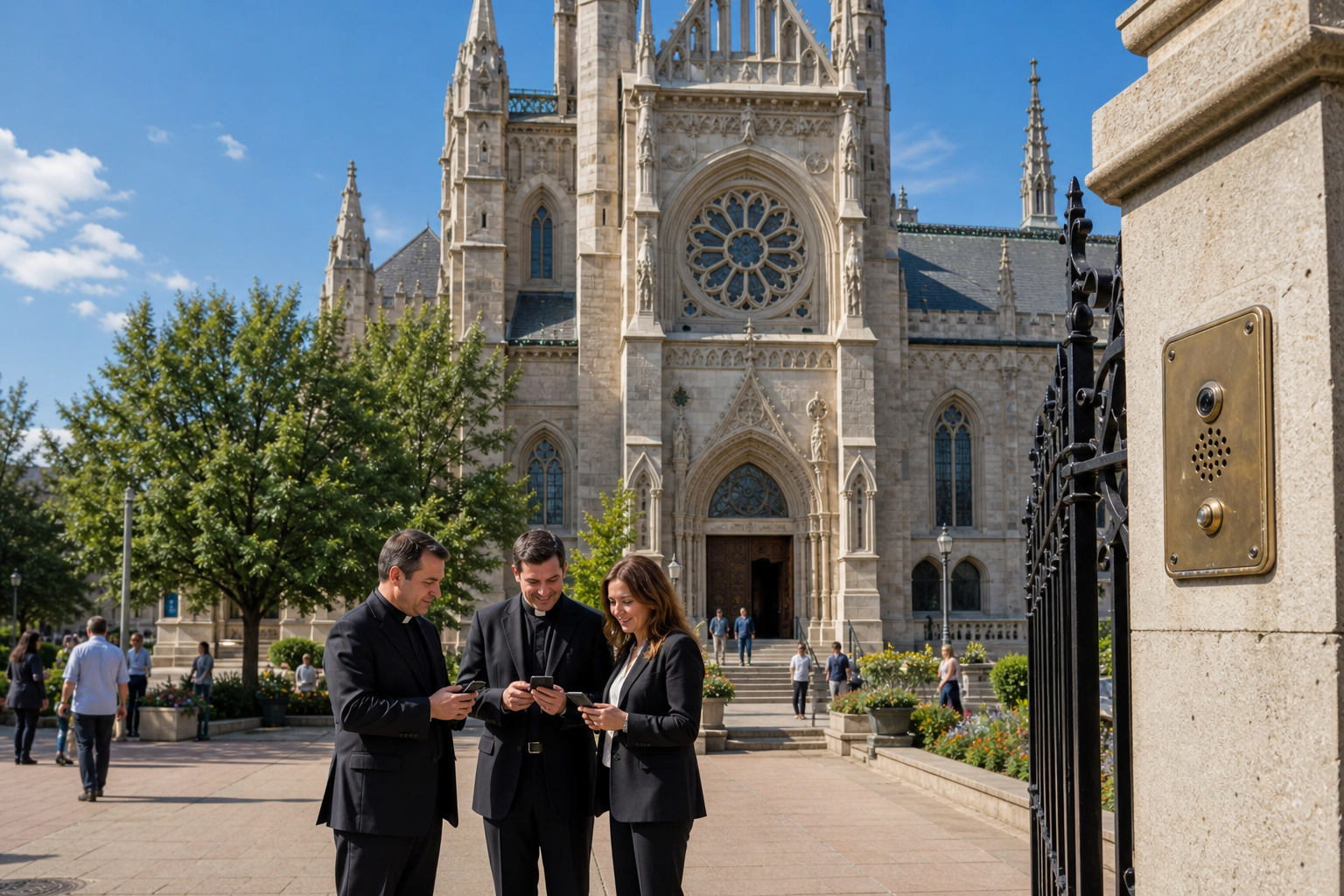
 High Country Workplace Technologies helped the Cathedral Basilica of the Immaculate Conception in Denver complete a two-stage communications modernization: first migrating its legacy Nortel PBX to Mitel Connect Cloud and later transitioning from Mitel Connect Cloud to RingCentral.
Throughout both migrations, HCWT preserved the Cathedral’s established call routing and ensured that its ring-down door phone continued to operate.
Project at a glance
Customer: Cathedral Basilica of the Immaculate Conception
Location: Denver, Colorado
Industry: Church and religious organization
Original phone system: Nortel PBX
First cloud platform: Mitel Connect Cloud
Current communications platform: RingCentral
Implementation partner: High Country Workplace Technologies
Special requirement: Preserve the existing ring-down door phone
Migration priorities: Maintain established telephone numbers, call routing and essential building-access communications
Project status: Successfully implemented
What was the Cathedral’s communications journey?
The Cathedral’s modernization began when HCWT migrated its aging Nortel PBX to Mitel Connect Cloud.
That initial project moved the Cathedral away from an obsolete on-premises telephone system and established a cloud-based communications environment for its clergy and staff.
When it later became appropriate to replace Mitel Connect Cloud, the Cathedral again worked with HCWT—this time to migrate to RingCentral.
Because HCWT understood the Cathedral’s existing telephone numbers, call routing, users and specialized door-phone requirements, it could carry that institutional knowledge into the second migration.
Why did the Cathedral move from Mitel Connect Cloud to RingCentral?
The Cathedral needed a current cloud communications platform capable of supporting its ongoing operational requirements.
Migrating to RingCentral allowed the Cathedral to retain the benefits of cloud communications while moving away from Mitel Connect Cloud. The new platform provides centralized administration and supports communications across desk phones, computers and mobile devices for authorized users.
The migration required HCWT to:
- Document the existing Mitel Connect Cloud environment
- Preserve the Cathedral’s established telephone numbers
- Recreate existing inbound call routing
- Maintain access to clergy and staff
- Preserve voicemail and unanswered-call handling
- Keep the ring-down door phone operational
- Test critical call paths before completion
- Minimize disruption to Cathedral operations
Why was the ring-down door phone an important requirement?
The Cathedral’s ring-down door phone supports a specialized building-access workflow.
When someone activates the door phone, it automatically calls a predetermined destination. The visitor does not need to dial a telephone number or extension.
Specialized devices such as door phones can easily be overlooked during a cloud migration because they may not appear on a standard employee or telephone inventory. Their operation may also depend on analog connectivity or a call path designed for the previous telephone system.
HCWT incorporated the door phone into both stages of the Cathedral’s communications modernization:
- During the original migration from Nortel to Mitel Connect Cloud
- During the subsequent migration from Mitel Connect Cloud to RingCentral
As part of the RingCentral implementation, HCWT ensured that the door phone continued to reach its intended destination.
How did HCWT preserve the Cathedral’s call routing?
The Cathedral’s existing call routing had been developed around the ways clergy, staff, parishioners and visitors communicate.
Before migrating from Mitel Connect Cloud, HCWT documented the required call flows and identified how callers reached the appropriate people and resources.
The RingCentral configuration was designed to preserve essential elements such as:
- Routing for the Cathedral’s primary telephone number
- Access to clergy and staff
- Individual and departmental extensions
- Scheduled and after-hours routing
- Unanswered-call treatment
- Voicemail destinations
- Operation of the ring-down door phone
- Migrate selected Mitel phones to RingCentral.
This process focused on preserving the caller experience rather than merely transferring telephone numbers to a new provider.
How did HCWT complete the RingCentral migration?
1. Review the Mitel Connect Cloud environment
HCWT reviewed the Cathedral’s users, extensions, telephone numbers, phones, voicemail and existing call flows.
The discovery process also identified specialized requirements such as the ring-down door phone.
2. Design the RingCentral system
HCWT translated the Cathedral’s Mitel Connect Cloud configuration into an appropriate RingCentral design.
Users, extensions, voicemail destinations, schedules and routing rules were planned before the final transition.
3. Preserve the door-phone workflow
HCWT determined how the existing door phone would operate with RingCentral and configured its predetermined destination.
The completed call path was tested to confirm that activating the door phone continued to reach the correct recipient.
4. Recreate and test call routing
HCWT configured the required call flows within RingCentral and tested inbound, outbound and internal calling.
Testing included the main telephone number, individual extensions, voicemail handling, scheduled routing and the door-phone workflow.
5. Coordinate cutover and stabilization
HCWT supported the Cathedral throughout the transition from Mitel Connect Cloud to RingCentral.
After cutover, HCWT validated the Cathedral’s telephone-number routing and helped address any operational adjustments identified as users began working with the new platform.
What were the results?
The Cathedral Basilica of the Immaculate Conception now operates on a modern RingCentral communications platform.
Successful transition between cloud platforms
The Cathedral moved from Mitel Connect Cloud to RingCentral without returning to an on-premises PBX.
Preserved call routing
The RingCentral environment maintains the essential routing needed to connect callers with the appropriate clergy and staff.
Continued operation of the door phone
The existing ring-down door phone remained operational following the transition to RingCentral.
Retained telephone numbers
The Cathedral preserved the established telephone numbers used by parishioners, visitors and community organizations.
Cloud-based administration
Authorized administrators can manage users, extensions and routing through RingCentral’s cloud-based tools.
Long-term technology continuity
HCWT supported the Cathedral through its original migration from Nortel to Mitel Connect Cloud and its subsequent migration from Mitel Connect Cloud to RingCentral.
Why is long-term partner continuity valuable?
A communications provider that has supported multiple generations of a customer’s telephone environment understands more than the current list of extensions.
It may also understand:
- Why certain telephone numbers are published
- How callers reach specific people or departments
- Which devices require specialized connectivity
- How unanswered and after-hours calls should be handled
- Which workflows must remain available during cutover
HCWT’s history with the Cathedral helped reduce the risk of overlooking requirements that had originated in the Nortel environment and continued through Mitel Connect Cloud.
Frequently asked questions
Can an organization migrate from Mitel Connect Cloud to RingCentral?
Yes. An organization can migrate from Mitel Connect Cloud to RingCentral after documenting its users, extensions, telephone numbers, call routing, voicemail, schedules, devices and integrations.
Can existing Mitel Connect Cloud call routing be recreated in RingCentral?
Yes. Most call routing can be recreated using RingCentral users, extensions, auto attendants, call queues, schedules, voicemail and routing rules. The existing configuration should be documented before migration.
Can an existing door phone work with RingCentral?
Many door phones can be retained, although compatibility depends on the device and how it connects. An analog door phone may require an analog telephone adapter or another interface.
What is a ring-down door phone?
A ring-down door phone automatically calls a predetermined extension, user or group when activated. The visitor does not need to dial a telephone number or extension.
Can existing telephone numbers be retained?
Yes. Existing telephone numbers can generally be transferred from Mitel Connect Cloud to RingCentral through number porting. Ownership and carrier records should be verified before scheduling the transition.
What specialized devices should be identified during a cloud migration?
The migration team should check for door phones, paging systems, fax machines, alarms, elevator phones, emergency phones and other analog or specialized devices.
Does HCWT migrate Mitel Connect customers to RingCentral?
Yes. HCWT helps organizations document their Mitel Connect environments and migrate users, numbers, call flows, workgroups, voicemail and supported devices to RingCentral.
Does HCWT support churches and religious organizations?
Yes. HCWT helps churches, parishes, schools, diocesan organizations and other religious institutions evaluate, implement and support business communications systems.
Planning a Mitel Connect Cloud migration?
HCWT helps organizations migrate from Mitel Connect Cloud, Mitel Connect and legacy ShoreTel systems to RingCentral and other modern communications platforms.
Services can include:
- Mitel Connect Cloud discovery
- User and extension inventories
- Telephone-number porting
- Call-flow documentation
- RingCentral design and configuration
- Auto attendants and call queues
- Door-phone and analog-device planning
- Paging integration
- E911 planning
- Device deployment
- User and administrator training
- Cutover and testing
- Post-migration support
Contact HCWT to schedule your migration to RingCentral